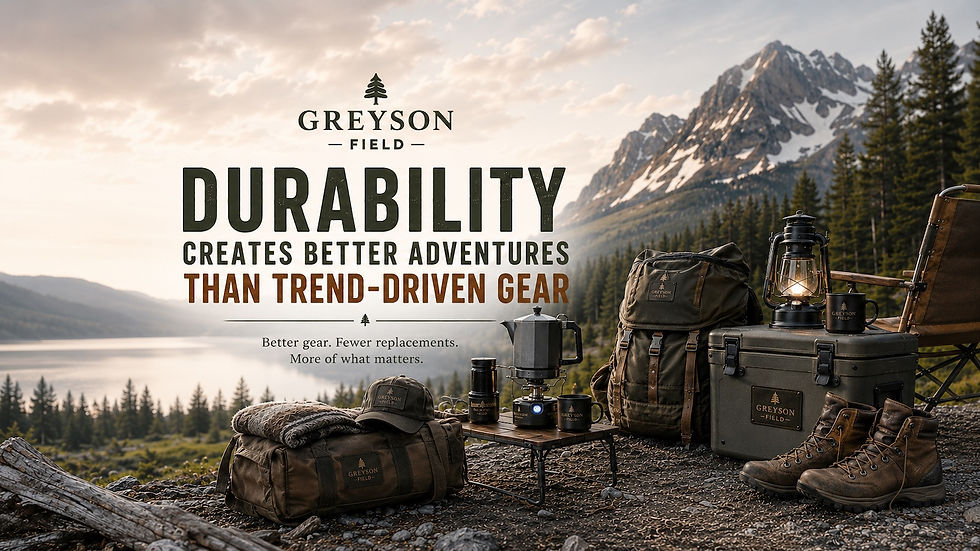
Durability Creates Better Adventures Than Trend-Driven Gear
BEFORE YOU START
Outdoor gear is easy to buy.
Reliable outdoor gear is something else entirely.
Every year brings new products, new features, new materials, and new trends designed to capture attention. Some innovations are genuinely useful. Others are simply different enough to encourage another purchase.
Yet many experienced outdoor enthusiasts eventually reach the same conclusion.
The gear that creates the best experiences is often not the newest. It is the gear that consistently performs when conditions become challenging.
Before evaluating your own equipment, take a moment to think about what has served you well over time.
Ask yourself:
Which pieces of gear have earned your trust through repeated use?
Have you ever replaced an item simply because something newer became available?
Do you prioritize durability or features when making purchases?
Which equipment continues performing well years after it was purchased?
Would you rather own more gear or more dependable gear?
The answers often reveal that memorable outdoor experiences depend less on following trends and more on having equipment that performs reliably when it matters most.
As you read through this guide, focus on the long-term value of durability, dependability, and thoughtful design. The goal is not to avoid innovation. The goal is to build an outdoor system around gear that supports your adventures year after year rather than chasing every new trend that appears.
Outdoor gear is often marketed as transformation.
A new jacket promises confidence. A new backpack promises freedom. A new camp accessory promises comfort. A new transport system promises adventure. A new tool promises preparedness. A new color, shape, or seasonal release suggests that the previous version of outdoor living was somehow incomplete.
The message is constant: better recreation comes from newer gear.
But most people who spend enough time outdoors eventually learn something quieter.
Better adventures are rarely created by trend-driven equipment.
They are created by durable systems that work repeatedly, disappear into the experience, and do not ask to be replaced before their purpose has been fully understood.
At Greyson Field, durability is not viewed as a rugged aesthetic. It is not about looking more extreme, more technical, or more heavily equipped than necessary.
Durability is about trust. It is about material choices, function, restraint, and the confidence that equipment will support an experience instead of interrupting it.
A durable system does not need to announce itself.
It proves its value through use.
Trend-Driven Gear Often Solves the Wrong Problem
Outdoor trends are not always useless.
Sometimes they introduce better materials, lighter construction, smarter storage, improved weather resistance, or more efficient design. Innovation matters. Good equipment evolves because real outdoor use reveals what needs to improve.
The problem begins when trend becomes the reason for ownership.
At that point, gear is no longer selected because it solves a specific problem. It is selected because it appears current. It photographs well. It matches what others are carrying. It promises identity rather than function.
This is how recreational systems become crowded.
A person buys a bag before understanding what needs to go inside it. A camp table before knowing where it fits in the layout. A jacket before understanding the climate it must actually handle. A transport accessory before knowing whether it improves access or merely adds volume. A tool because it looks capable, not because it fills a defined role.
Trend-driven gear often creates the feeling of preparation without the structure of preparation.
That distinction matters.
A trip does not become easier because more equipment is present. It becomes easier when the right equipment is present, placed well, built well, and suited to the environment.
Durability Is a Form of Calm
Durability is usually discussed in practical terms.
Will it hold up?
Will it resist weather?
Will it tolerate repeated use?
Will it survive travel, abrasion, moisture, dirt, sun, cold, packing, unpacking, and storage?
Those questions matter. But durability also has an emotional effect.
Reliable gear calms the experience.
A chair that stays stable on uneven ground means no one is constantly adjusting it. A backpack that carries weight well means the trail feels less punishing. A jacket that blocks wind properly means weather becomes manageable instead of distracting. A storage system that keeps equipment protected means arrival does not begin with checking for damage. A lantern that works consistently after dark changes the entire feel of camp.
Durability reduces the number of things people have to worry about.
That reduction is part of what makes outdoor recreation feel restorative.
People often go outside to escape the over-stimulation of ordinary life. Yet poorly chosen gear can create its own form of noise: failing zippers, uncomfortable straps, cracked plastic, flimsy legs, wet contents, weak handles, unstable surfaces, and equipment that must be handled delicately in conditions that are anything but delicate.
Durable equipment lowers that noise.
It lets the setting become central again.
Material Integrity Matters More Than Visual Ruggedness
Outdoor markets are full of visual cues designed to suggest toughness.
Dark colors. Oversized hardware. Tactical shapes. Aggressive textures. Heavy branding. Rugged language. Reinforced-looking details that may or may not improve actual performance.
But visual ruggedness is not the same as material integrity.
Material integrity is quieter.
It shows up in the fabric that resists abrasion without becoming unnecessarily stiff. The zipper that does not fail under tension. The stitching that holds where stress naturally gathers. The frame that remains stable over repeated use. The coating that handles weather without peeling quickly. The hardware that does not corrode after a season outside. The sole that grips properly without separating. The handle that carries weight without cutting into the hand.
These qualities rarely create instant excitement.
They create long-term trust.
This is why durability requires slower evaluation than trend-based buying. A product can look impressive in a listing, showroom, or staged photo and still perform poorly over time. It can appear rugged without being repairable. It can be heavy without being strong. It can be expensive without being thoughtfully made.
Refined recreational living depends on looking past surface signals.
Not every trip requires premium equipment. Not every item needs to be heirloom-level. But the pieces that carry weight, protect people, support shelter, manage weather, preserve food, organize movement, or improve safety should be evaluated beyond appearance.
The outdoors does not reward gear for looking capable.
It rewards gear for being capable.
The Best Gear Earns Its Place Repeatedly
One of the most useful questions in outdoor equipment planning is simple:
Will this item earn its place more than once?
That question changes how gear is evaluated.
A trend-driven item may feel compelling at purchase, but after a few trips it often becomes harder to justify. It takes up space. It requires storage. It adds weight. It complicates packing. It duplicates something else. It works in only one narrow situation. It creates more management than value.
Durable gear tends to behave differently.
It becomes familiar.
A well-made carry system develops a known packing rhythm. A reliable layer becomes the one reached for first. A sturdy table becomes part of the camp sequence. A quality cooler, lantern, boot, pack, or storage container becomes less interesting visually and more valuable practically.
The best outdoor gear is often not noticed every time it succeeds.
It becomes part of the background structure that allows the experience to happen.
This is a useful standard for Greyson Field’s perspective. Equipment should not need constant attention to justify itself. It should integrate. It should support movement, gathering, comfort, safety, or clarity in a way that becomes more valuable over time.
Gear that earns its place repeatedly becomes part of a system.
Gear that does not becomes clutter.
Restraint Creates Stronger Outdoor Systems
There is a point where more equipment begins to weaken the experience.
A camp can have too many bins. A vehicle can carry too much weight. A backpack can become crowded with “just in case” items that are not truly necessary. A wardrobe can hold too many specialized pieces that never align with real conditions. A cooking setup can become so elaborate that no one wants to use it.
Restraint is not deprivation.
It is design discipline.
A restrained outdoor system asks: What improves the experience? What protects comfort or safety? What reduces friction? What supports the way we actually travel? What will we use repeatedly? What can be left behind?
These questions are especially important because outdoor gear has a way of accumulating. Each new trip reveals a small inconvenience, and the instinct is often to solve every inconvenience with another object. Sometimes that is appropriate. Often, the better answer is to improve the system rather than add to it.
A better packing sequence may solve more than a new container.
A more versatile layer may solve more than three specialized garments.
A stronger table may solve more than several unstable surfaces.
A reliable everyday pack may solve more than a collection of awkward bags.
A well-considered lighting plan may solve more than simply bringing more lights.
Restraint makes systems easier to understand.
Easier systems are more likely to be used well.
Durability Supports Beginners and Experts Differently
Durability benefits every level of outdoor recreation, but not always in the same way.
For beginners, durable equipment reduces discouragement.
When early trips are full of avoidable failures, people may assume outdoor recreation is naturally uncomfortable or frustrating. They may not realize that a collapsing chair, leaking tent, uncomfortable pack, weak lantern, or poor footwear is not a rite of passage. It is often a sign of equipment mismatch.
Reliable gear gives beginners margin.
It makes the learning process less punishing.
For experienced travelers, durability creates efficiency.
They have already learned what works, what fails, what is worth carrying, and what is not. Their systems become more refined because repeated use has exposed unnecessary complexity. They often value equipment that can be trusted across conditions rather than items that only perform in ideal circumstances.
This shared value is one reason durability is such a strong foundation for Greyson Field.
It does not exclude beginners.
It does not condescend to experts.
It creates a common language: choose equipment that supports the experience with enough reliability that the outdoor environment remains the focus.
Seasonal Use Reveals Quality Quickly
Outdoor gear that performs well in mild summer conditions may not hold up as well in shoulder seasons.
Cool mornings, wet ground, wind, early darkness, snow patches, mud, and temperature swings reveal weaknesses quickly.
A jacket that seemed adequate in town may fail against wind exposure. Boots that felt fine on dry trails may disappoint on wet rock or uneven terrain. A storage bag that worked in good weather may absorb moisture. A camp chair that felt stable on flat grass may wobble on rough ground. A lantern that seemed bright enough may not hold charge through a longer evening.
Seasonal variation is one of the best tests of durability.
It also makes outdoor recreation feel more real.
Not every trip happens in perfect weather. Not every campsite is dry and level. Not every trail is warm and open. Not every morning starts gently. Real outdoor living involves conditions that change, and durable systems reduce the stress of those changes.
This does not mean every person needs expedition-level gear.
Most people do not.
But it does mean that equipment should be selected with honest awareness of use. If someone regularly travels in mountain environments, wet forests, windy deserts, cool coastal areas, or changing elevations, their gear should reflect that reality.
Durability is not about overbuilding every item.
It is about matching material quality to actual use.
The Financial Case for Durability Is Often Long-Term
Cheap gear can be useful.
There are times when a lower-cost item makes sense, especially for occasional use, testing a new activity, or filling a temporary need. Not every purchase needs to be high-end. Not every recreational system should begin with premium investment.
But over time, repeated replacement becomes its own cost.
A flimsy chair replaced twice may end up costing more than one better chair. A weak bag that fails during travel creates both replacement cost and inconvenience. Poor footwear can turn a trail into discomfort. Low-quality storage can damage the gear inside it. A cheap layer that does not perform may force additional purchases.
Durability is often less about spending more immediately and more about understanding where quality matters most.
Some categories deserve stronger investment because failure affects the whole experience:
footwear
outerwear
shelter
lighting
storage
seating
load-bearing carry systems
vehicle transport systems
weather protection
core field essentials
Other categories can remain simple.
The refined approach is not “buy the most expensive version.”
It is “understand what this item is responsible for.”
Responsibility determines investment.
Trend Cycles Fade, But Good Systems Age Well
A durable outdoor system often becomes better with familiarity.
People learn how to pack it. How to deploy it. Where it belongs. What it pairs with. What it replaces. What it makes easier. What conditions it handles best.
This familiarity is part of the value.
Trend-driven gear often loses appeal when the novelty fades. Durable gear becomes more trusted as use accumulates.
A well-worn jacket that still performs can feel more valuable than a newer one that only looks current. A scuffed table that has supported years of meals becomes part of the rhythm. A reliable pack carries memory along with function. A lantern used repeatedly begins to define evening ritual. A storage system with marks from real travel becomes evidence of use rather than imperfection.
This is where durability becomes more than practicality.
It becomes continuity.
Outdoor experiences are built through repetition: the return to a trail, the annual trip, the familiar campsite, the seasonal route, the weekend rhythm, the morning coffee outside, the fire at dusk.
Gear that lasts participates in that continuity.
It supports memory instead of constantly resetting the system.
The Greyson Field Perspective
At Greyson Field, durability is not pursued for its own sake.
It is pursued because outdoor recreation depends on trust.
Trust in the pack that carries what matters. Trust in the layer that handles cold wind. Trust in the light that works after dark. Trust in the shelter that makes rest possible. Trust in the transport system that protects equipment in motion. Trust in the simple tools that help an outdoor space feel settled rather than improvised.
Trend-driven gear often asks for attention.
Durable gear gives attention back.
It allows people to notice the trail, the meal, the conversation, the weather, the view, the quiet, the shared moment, the sense of arrival.
That is why durability creates better adventures.
Not because everything must be heavy, expensive, technical, or permanent.
But because the right durable pieces reduce friction again and again.
They make systems calmer.
They make movement easier.
They make outdoor spaces more dependable.
They help people buy with intention rather than react to every new release.
And over time, they support the kind of recreational life that feels less like accumulation and more like belonging.
Better adventures are not built from constant replacement.
They are built from equipment, systems, and choices that last long enough to become part of the experience.


